
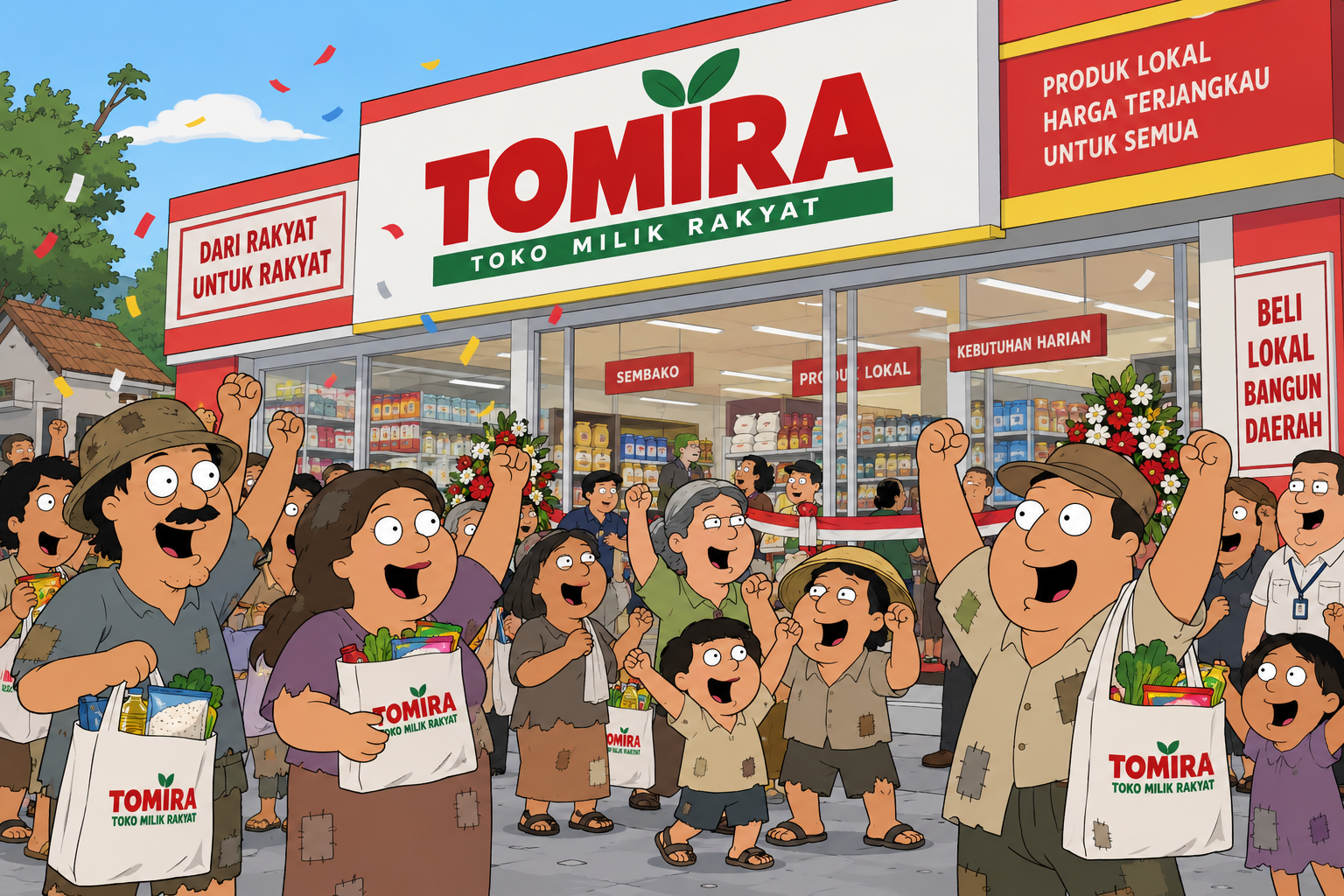
Early this week, New York came closer to the idea of a government-owned shop or, in Indonesia, we used to have this concept called Tomira (Toko Milik Rakyat). Tomira came from the idea that Indonesia faces competition from the duopoly of convenience store franchises Alfa and Indomaret, which raised concerns that they might disrupt fair competition for smaller, local shops. Tomira itself then became a great example from Kulon Progo that attracted interest in other regions, including Magelang. They not only run their government-owned shops but also force the big franchises to close their shops.
However, this noble concept is not always well received. In the end, Tomira, which is labelled as selling only local products, is partnering with two giants to maximise profit, minimise cost, and improve their system. Although they still sell products, the big players take a bigger share of the profit because they have networks and experience that set them apart from new competitors, even though the competitors have government support. A similar situation has actually happened with the “Fair Go Grocers”.
Tomira Of New York
A glance at the Fair Go Grocers: The Green Institute’s “Fair Go Grocers” proposal aims to create a government-owned supermarket chain of 624 stores to challenge Australia’s Coles–Woolworths duopoly and reduce grocery prices by up to 22%, with an estimated cost of A$25.1 billion over five years.
While the proposal seeks to improve affordability, support farmers, and increase competition, significant concerns remain about its economic feasibility. Unlike New York’s much smaller plan for five publicly owned supermarkets, Fair Go Grocers would require rapid nationwide expansion, compulsory acquisition of existing stores, major infrastructure investment, and substantial procurement and logistics capabilities.
The homework is staggering; it is not a simple task, since experience and networking are needed because of the risk of losing the ability to address the hardships of building a chain that actually works.
Moreover, widening the price gap does not always solve the problem of building a fair economy. Critics argue that eliminating profit margins would not be sufficient to finance discounts of 22–30%, while paying higher prices to suppliers could further increase costs.
The proposal also faces challenges related to construction costs, site availability, workforce shortages, and the difficulty of achieving the scale and efficiency that has taken decades to develop. Therefore, although the proposal highlights legitimate concerns about supermarket concentration, alternative measures recommended by the ACCC—such as reducing barriers to entry, improving price transparency, and strengthening supplier protections—may offer a less costly and more practical way to improve competition.
The Better Idea
If Magelang wants to ensure everybody has strong buying power, having its own version of Tomira is not the answer. Hermann explained in his book (2021) that the biggest concern is that we have not set limits on capitalism. People have the freedom to open their businesses and treat every human need as a commodity.
The commodification process is actually dehumanising humans since now they cannot fulfil what should be their basic needs, as the business powerhouse holds them and takes a wider gap of profits that are actually acceptable in a business context but still inhumane from our perspective because we do not talk about ‘wants’, we are actually discussing essential items that people need to have to sustain a standard life as a human.
Equality is a noble concept, but it is not always about punishing success. To be clear, the first idea is to ensure that commodification or financialization does not undermine our willingness to build a society that treats people as human beings.
The government of Magelang can start by identifying what people need, then ensure they can access these basic needs without worrying that prices will skyrocket and they will have no opportunity to get these commodities.
Next, the government should implement safeguards so people either have a stable job or receive enough financial social support to live as human beings while searching for a permanent livelihood.
This solution is much smaller in terms of scale than Tomira or the upgraded version of Koperasi Desa. Yet, this simple yet systematic plan is more attainable, especially if we stop thinking about closing the gap and instead ensure that every person is treated as humanely as possible.