

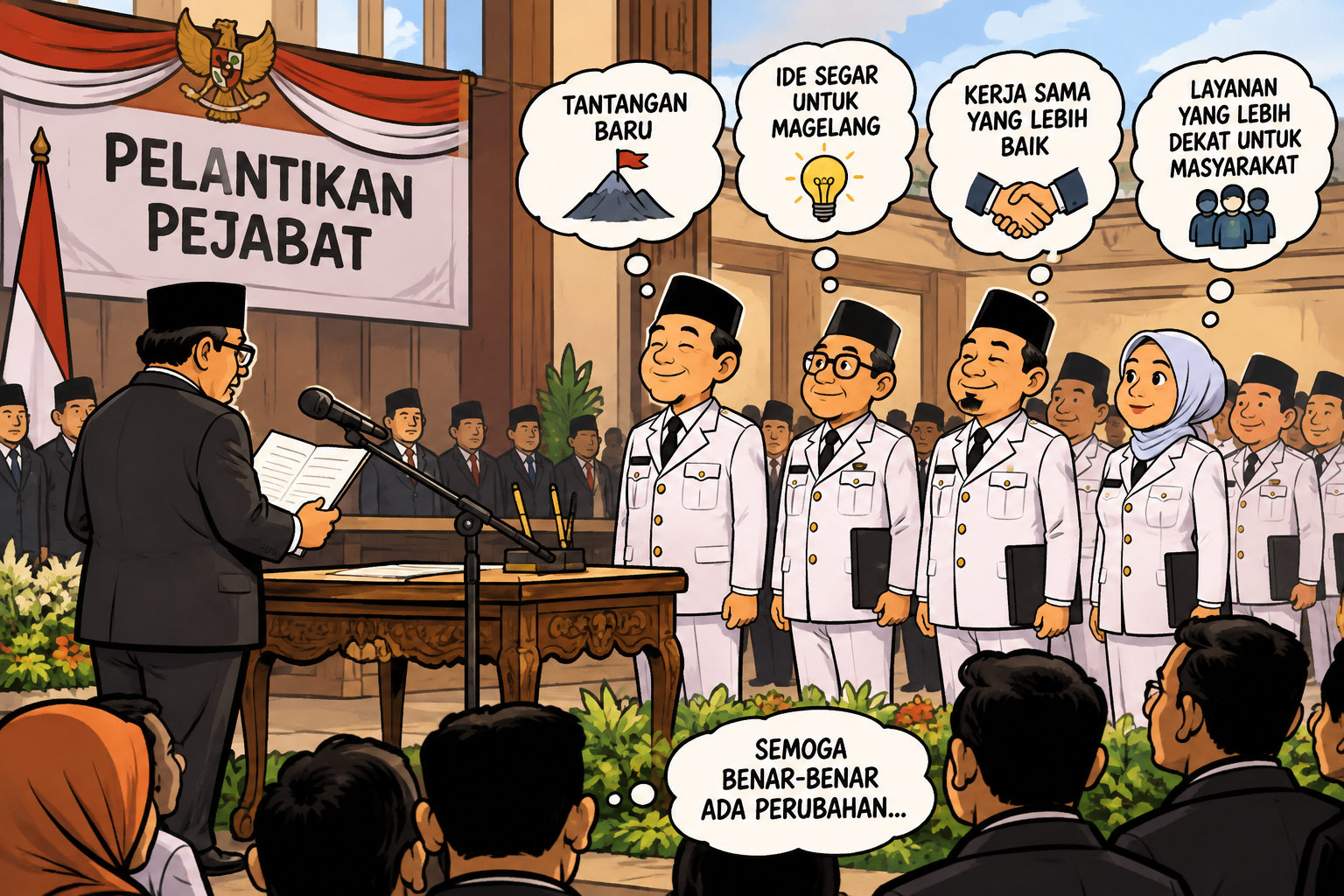
Magelang Regency has just rotated various roles in public administration. Several officials have now moved to their new posts. Surely, people expect this to improve public services. However, expectations often do not match reality. Rotating roles does not always solve recent problems.
I personally see that organisational management is always about a list of issues and how we overcome them. Nonetheless, the issue is often staying in the same position. Yet, the perspective can differ. For example, everybody knows poverty, but they have different views and solutions. Rotating roles is often a way to see if a new perspective is needed to solve the same issue. People who come might find solutions that are more efficient. Sadly, this case often does not happen as people expect. There is a reason why the expectation does not meet the reality.
Experience and Internalisation of the Issues are not Something That Happened Overnight
The number can be distracting; so can the data. People who assume a role feel urgent to act; this often translates into acting fast to ensure people see they are ‘working’. Yet, to internalise the issue and its problems, we need to be present.
Present means that you feel it; you are in the middle of society, and now you not only have the numbers that reflect the issue but also your personal connection to the issue, so you can do something about it. Your solution might not be perfect, but it is at least better than only the facts from the briefing that you got from specialised staff.
However, it is true that time is expensive and the clock is ticking. Becoming a public official means that you face people from different backgrounds and opinions. They do not always accept the idea that you need to internalise and personalise your response to issues. They want you to be fast.
Before the real solution is actually found, the person in charge might need to face another role without fulfilling the promise of his or her potential. I would call it the vicious circle of rotating roles.
Vicious Circle of Rotating Roles Might Happen in Magelang
I believe the threat I described may oversimplify the situation, but the pattern is real and demands a new approach. One approach is to have strong leadership from the regent (bupati).
The Bupati of Magelang should have a clear picture of the issue and know what kind of ideal Magelang he has in mind. Later, he can start choosing the best person for each position.
Not only does he choose the best person, but he also needs to know the best time for them to. He should be able to tell when it’s taken too long and another reformation is needed. Without a clear idea, the rotation can be messy, and we have another issue to solve.
It does not mean that another reformation cannot be done. Still, the idea is to have a systematic way of thinking when building ‘the system’. There will always be an opportunity to change the system. Hence, the idea of when it is needed and how it is done should at least be well reasoned.
In the end, a new person in a new post may come in with hopes, but having a strong foundation when the rotation is done is always more important. Therefore, rotating roles will fulfil its promises for further growth and development so Magelang can take further steps later on.
New officials should not view this politically; instead, they should see it as a development plan to improve people’s livelihoods.