

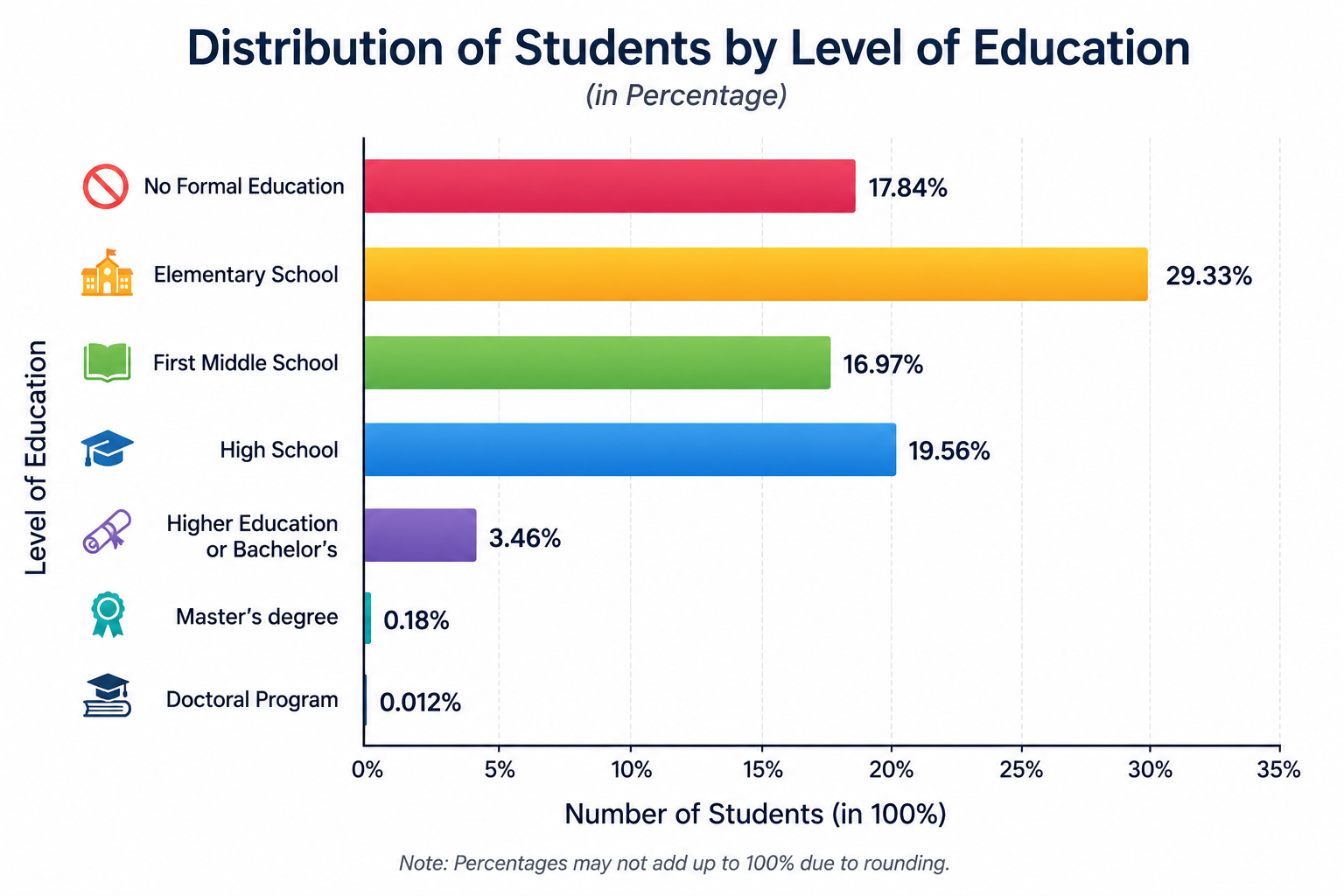


Based on the graph from Databoks showing levels of education in Magelang, elementary school graduates constitute the largest share of the resident population. 29.33% is representing close to 350 thousand residents. Meanwhile, residents with no educational background account for 17.84%, roughly 150 thousand Magelang residents. When it comes to the first middle school, only a little more than half of elementary graduates continue their studies, based on a rough comparison between first middle school graduates and elementary graduates. Interestingly, the number of high school students has increased significantly. It shows that the possibility of migrants moving to Magelang has increased the composition of students who finish high school. Meanwhile, in higher education, the number does not meet the 10% benchmark, indicating that students finishing higher education or earning their bachelor’s degrees are not part of the dominant social group in Magelang. Finally, the number of people who continue into post-bachelor programs does not even reach the one per cent benchmark; the number is even lower in doctoral programs.
The Dilemmatic Situation of Elementary School Graduates
Providing job opportunities is the government’s task, in partnership with industrial stakeholders. Nonetheless, there are many residents in Magelang who have only finished elementary school. Helping them secure a proper job with at least minimum-wage salaries will be challenging, since industrial stakeholders would not want to recruit workers who are not competent or competitive.
Nonetheless, there are two possible solutions to ensure that elementary school graduates get a livelihood. First, focusing on the small and medium enterprises, which in Indonesia are often called UMKM. This type of business has a minimal bar to recruit workers, and possibly can be an early access for the unemployed to get their first job. Secondly, to open an industry that needs a worker to do routine and simple tasks, such as the cigarette industry, which needs people to make cigarettes by hand.
Although two solutions are possible to implement, each has its own issues. For example, UMKM does not have a clear career path, and people often stay in the same place for a long time, with their salaries rising by no more than 5% each year. UMKM is also a business that does not have a long record of sustainability. It is often recommended to stay for three to five years, since the survival rate records do not seem promising. Moreover, when the business is growing, workers may not meet the company’s needs and are laid off, creating a vicious cycle as current workers then need to find another job.
On the other side, the second solution is not attainable in the era of automation, and most industries try to reduce the manpower in their industry due to their concern for human management as the most complex part of their business. There are too many stakes for them to carry on if they recruit as many locals as possible. Usually, the only way to encourage industrial actors to get involved is to offer incentives, ranging from tax holidays to simplified business permits. Yet, granting tax holidays would jeopardise government revenue, a risk many local governments try to avoid, since the central government has cut the residential budget, leaving local residential operations facing many obstacles.
The last solution is for the government to provide local certification, increasing their competencies to find livelihoods outside of Magelang while still transferring some money to their relatives in Magelang. Meanwhile, the government should also improve internet infrastructure in Magelang to support remote workers who often earn income from working abroad while at home. From this situation, the unemployment rate in Magelang can be deduced.