

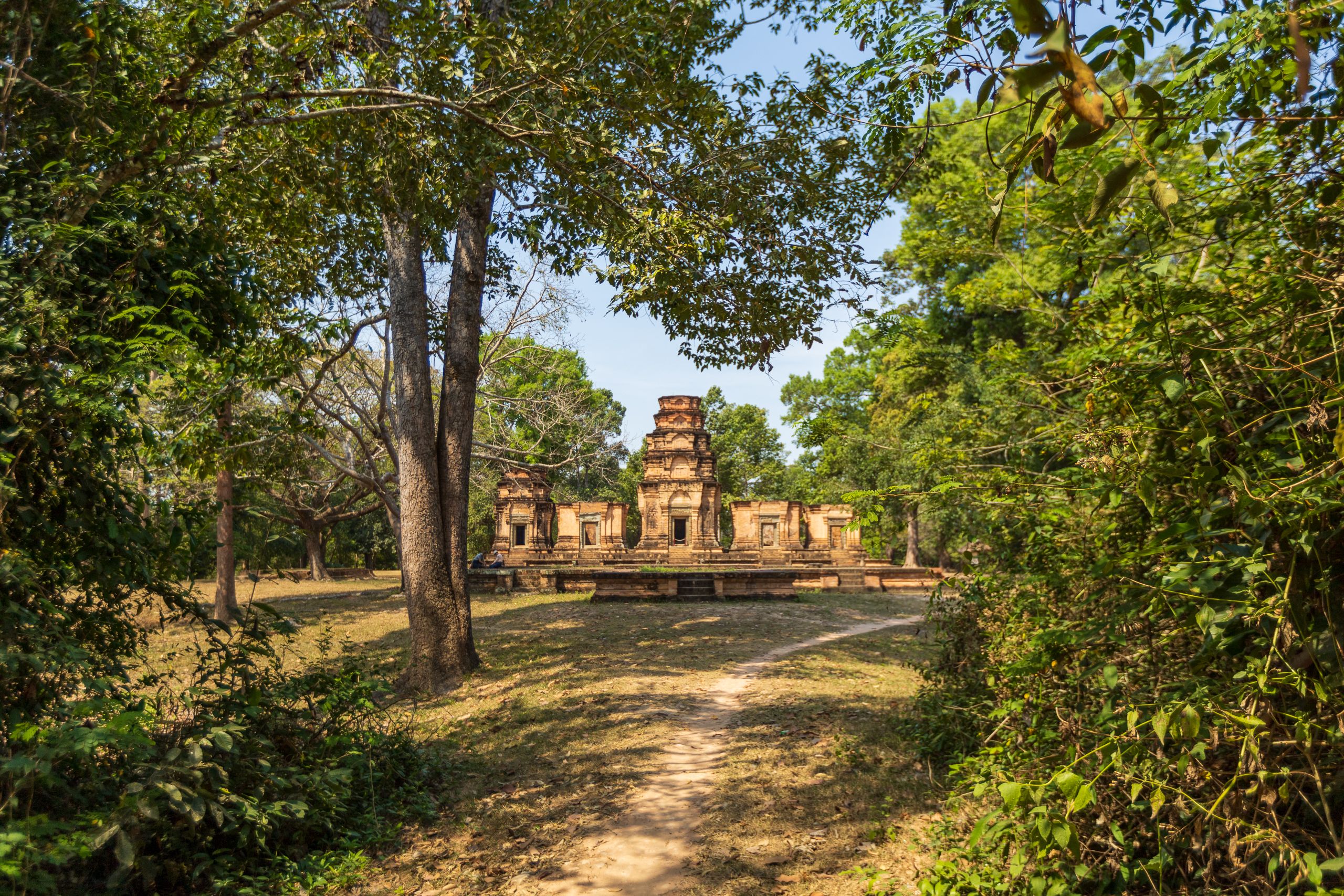
Candi is frequently labelled as a source of national pride. In Indonesia, Candi is translated as “temple” in English, which usually reflects a region’s national history; therefore, people often associate temples with something very important to defend. Often, attacks on Candi are associated with attacks on the whole nation.
Imagine if a Candi is on the border of two countries and both countries have a complex relationship. Both believe that the temple belongs to them, and losing the temple would spark even more hate in the future. This is what happened with Angkor Wat and Preah Vihear Temple.
The complex history of the Candi
Angkor Wat is not considered a temple. It is often called the ancient city. The reason is its vast area. It has five towers that reflect the lotus of life, and the reliefs on the temple are dedicated to Vishnu, a Hindu god. However, in this view, Vishnu is considered manifested in a human named Gautama. Therefore, the temple is associated with Buddhism rather than Hinduism. Founded by King Suryavarman II, the temple is a legacy of the Khmer.
Nonetheless, the Khmer were occupied by Thailand or Siam. Siam itself has left some marks on Angkor Wat, and the pride of Siam is in the temple too. For the Khmer, it is a form of provocation. Therefore, they call the area where the anciet site was built Siem Reap, or the Blood of Thai.
Nowadays, based on UNESCO’s recognition, Angkor Wat is recognised as Cambodia’s heritage. Yet Thailand has not given up. The kingdom feels that, though Angkor Wat is the asset of the Khmer, they think Preah Vihear belongs to them.
Preah Vihear, The Hidden Candi
Preah Vihear is dedicated to Siwa, the God of destruction. The location is hidden near the Dangrek Water Stream. Under the old agreement, the border between Siam and Cambodia was based on the Dangrek Water Stream. However, Cambodia took the Siva temple as an important monument and claimed it as its own, even though the temple is on Thailand’s side. The tension between the two countries then escalated to the point that they opened fire, resulting in some fatalities.
The International Court of Justice ultimately awarded it to Cambodia. The reason was primarily Thailand’s acceptance of the 1907 historical border map. The dispute originated from the 1904 Franco-Siamese Treaty, which established the boundary between French-controlled Cambodia and the Kingdom of Siam (modern-day Thailand) along the watershed line of the Dangrek Mountains. However, a map known as the Annex I Map, prepared by French officials in 1907, placed the Temple on the Cambodian side of the border. Although Thailand later argued that the map did not accurately reflect the treaty’s geographical provisions, the ICJ concluded that Siam had received and accepted the map without raising timely objections.
Thailand has accepted the situation with a bitter taste, and the conflict often escalates in the vicinity of the temple.
The Lesson From The Temple Case
The ironic thing about temples like temples in Thailand and Cambodia, or Borobudur in Indonesia, for instance, is that we consider them part of our pride, but we rarely invest in learning about and caring for this architectural legacy. Temples have been downgraded into egoistic symbols of nations, sometimes used only as fuel for already heated relationships between countries. Yet not many realise that temples are important for understanding the past and how it affects our lives, especially in tracing the roots of our social problems, which might be solved if we trace back history. Yet having something to be proud of and underlining our arrogance is somehow more important than learning who we truly are.